
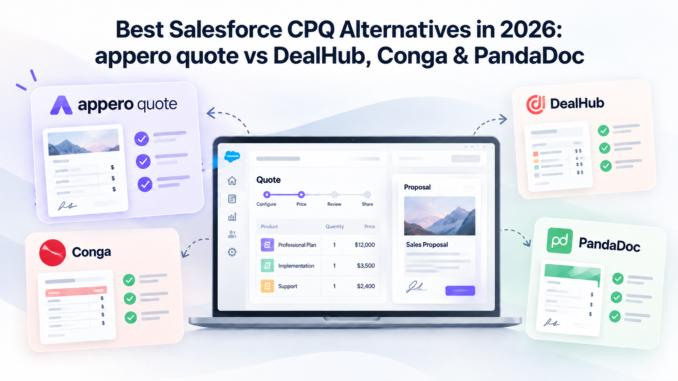
Choosing the best Salesforce CPQ alternatives in 2026 is less about finding a one-to-one replacement for it. It is more about matching the solution to the company's sales model, product complexity, and Salesforce architecture.
The CPQ market itself reflects this variety. Gartner's Critical Capabilities research evaluates CPQ applications across 7 use cases and 12 critical capabilities, covering scenarios from direct and channel sales to service selling, complex manufacturing, solution selling, composable CPQ, and long-term deal negotiation. This reflects how differently CPQ solutions can be designed, even when they provide the same core quoting functions.
As a result, evaluating a Salesforce CPQ alternative requires more than checking whether it supports products, pricing, discounts, approvals, and quote generation. The more relevant question is how those capabilities fit the company's sales process and Salesforce environment. Some solutions keep CPQ closely within Salesforce, while others operate as separate platforms and extend quoting into proposals, contracts, and other parts of the sales process.
For this comparison, we selected 4 established CPQ solutions that integrate with Salesforce: appero quote, Conga Advantage CPQ, DealHub, and PandaDoc. They differ in product scope, implementation approach, target customers, and the broader sales capabilities they provide. Comparing them side by side can help you assess which solution fits your Salesforce environment, quoting requirements, and business needs.
At a Glance
- Best for Salesforce-Native CPQ: appero quote. A focused CPQ application built as a native Salesforce app for product configuration, pricing, quote calculation, and document generation.
- Best for Complex Product Configuration: Conga Advantage CPQ. Designed for complex product catalogs and configuration requirements, with rules, dependencies, product relationships, and advanced configuration capabilities.
- Best for Quote-to-Revenue Workflows: DealHub. Brings quoting, approvals, contracts, subscriptions, billing, and buyer collaboration into a single revenue workflow.
- Best for Proposal Creation and E-Signature: PandaDoc. Combines proposal and document creation with templates, collaboration, and built-in eSignature capabilities for customer-facing sales documents.
What to Consider When Choosing the Best Alternatives to Salesforce CPQ
When evaluating a CPQ solution or Salesforce Revenue Cloud alternatives, it is worth looking beyond the feature list and considering how the solution fits within the Salesforce environment, how much of the sales process it covers, and what implementation and administration will require.
This matters because the decision is not only about functionality. A Simon-Kucher study found that only 40% of pricing and quoting automation implementations fully succeed, highlighting clear scope, system integration, and organizational readiness as important factors.
Several areas are particularly relevant when assessing a Salesforce quoting app:
- Salesforce integration: how the solution connects with Salesforce and how Salesforce data is used throughout the quoting process.
- CPQ capabilities: product configuration, pricing, discounts, approvals, quote creation, and other core quoting requirements.
- Implementation and administration: how the solution is set up and configured and what administrators need to manage.
- Security: available security features, certifications, and compliance information.
- Usability: how sales users work with the solution when creating and managing quotes.
- Additional functionality: capabilities beyond core CPQ, such as proposals, contracts, e-signature, subscriptions, or broader revenue processes.
With these considerations in mind, it is useful to start by looking at each solution on its own, including its main capabilities, Salesforce integration, and approach to CPQ.
appero quote: Salesforce-Native CPQ with a Focus on Quoting
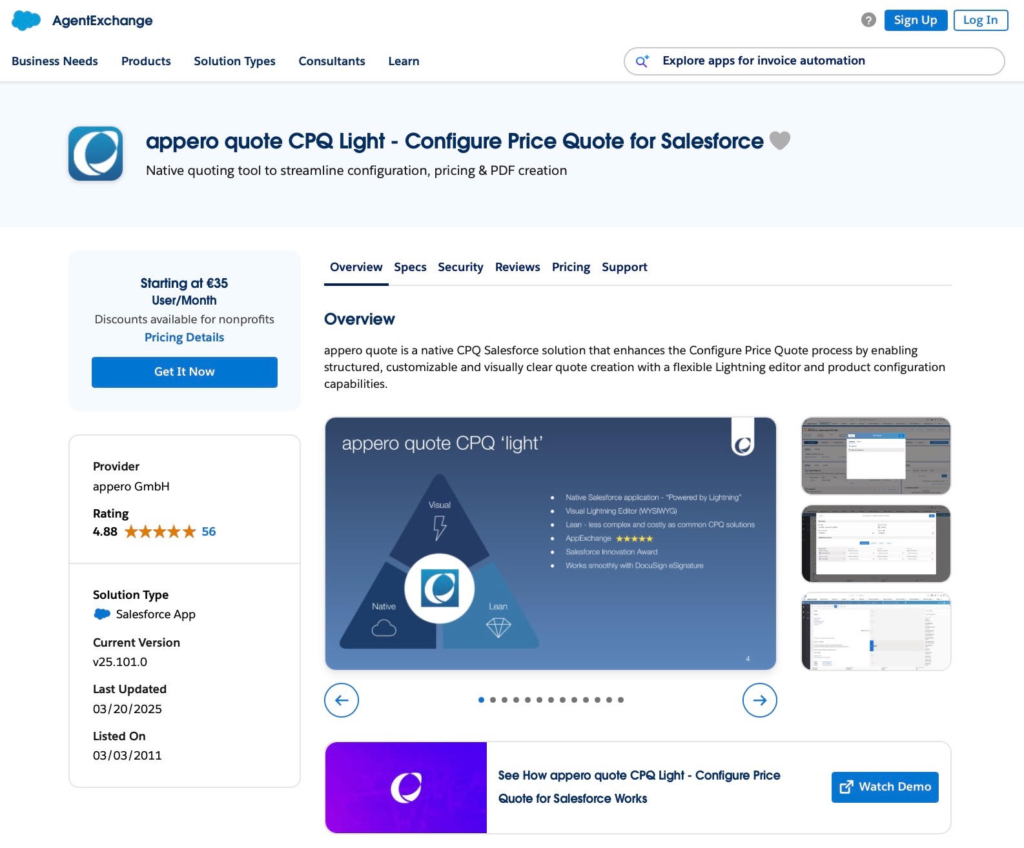
appero quote CPQ Light on AppExchange
appero quote, developed by appero GmbH, is a Salesforce native CPQ solution focused on product configuration, price calculation, quote creation, and quote-document generation. The application natively integrates into the Salesforce opportunity process, with products, pricing, quote templates, and quote data handled within the Salesforce environment.
You can consider the product as one of the PandaDoc on Salesforce CPQ alternatives, as it combines pricing logic with a visual quote editor. Users can configure products, apply pricing and discount rules, create quotes from templates or previous quotes, and generate PDF documents. It is possible to insert Salesforce data into quotes through merge fields, including information from opportunities, accounts, contacts, products, quotes, and users.
Key features:
appero quote supports the core functions needed for structured quoting, including:
- Product configuration: Product Groups, Product Properties, bundles, accessory products, and product dependencies.
- Pricing and discounts: graduated prices, price dependencies, surcharges, manual and automated discounts, and discount matrices.
- Quote creation: quote templates, reusable modules and content, and a visual Lightning Quote Editor.
- Salesforce data: merge fields that dynamically insert Salesforce record values into quotes.
- Quote documents: customizable quote layouts, formatting options, and PDF generation.
Ideal use cases:
- Businesses that want a native Salesforce CPQ for product configuration, pricing, quoting, and document generation.
- Teams with standard product bundles, dependencies, and pricing requirements that do not need highly complex enterprise configuration.
- Salesforce CPQ customers looking for a focused CPQ replacement without moving to a broader revenue-management platform.
appero quote CPQ light focuses on the core CPQ process within Salesforce, combining product configuration, pricing and discount logic, quote creation, and document generation. Its Salesforce-native architecture keeps the quoting process closely connected to Salesforce data and the opportunity process.
Conga Advantage CPQ: Enterprise CPQ for Complex Product Configurations
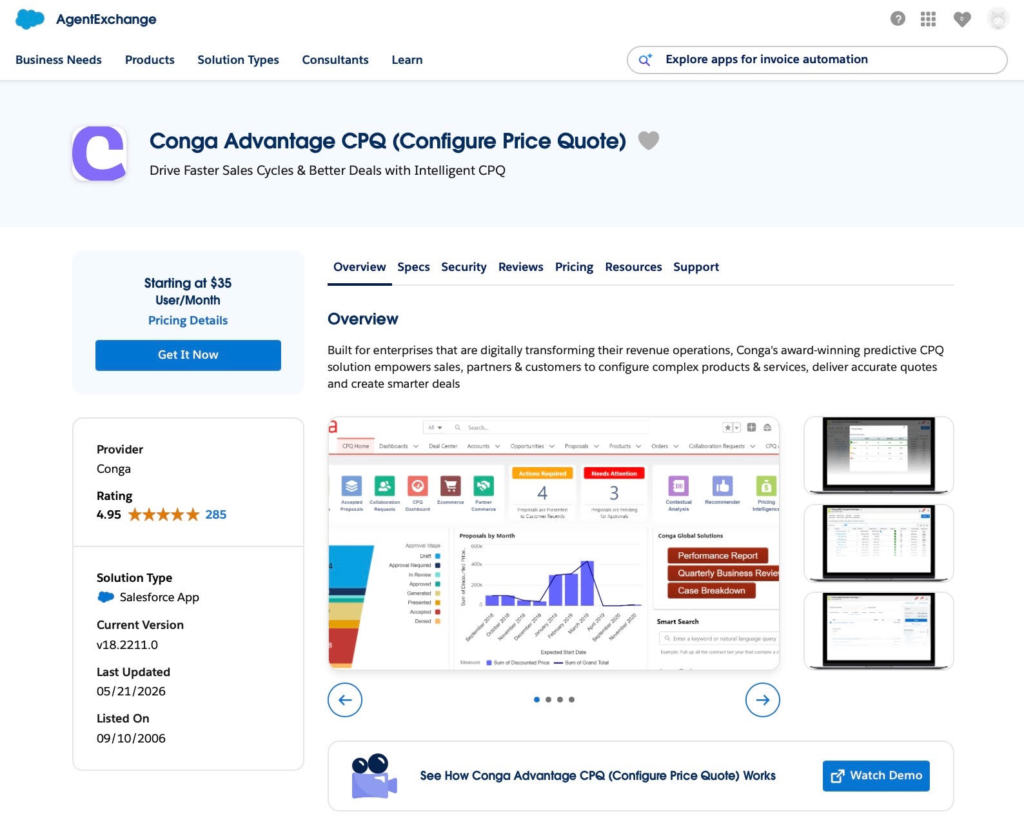
Conga Advantage CPQ on AppExchange
Conga Advantage is an enterprise CPQ application from Conga, available on the Salesforce AppExchange. It is mostly for sales organizations that need to configure complex products and services, apply pricing and business rules, and generate quotes and proposals. The solution supports complex products and services, guided selling, rules-based configuration, and multiple sales channels.
Key features:
Conga Advantage CPQ supports:
- Product configuration: standalone products, bundles, options, attributes, categories, and configuration rules.
- Guided selling: guided product configuration based on attributes, options, and rules.
- Pricing and adjustments: price lists, price rules, discounts, markups, promotions, and contract pricing.
- Product and pricing rules: dependencies, constraints, eligibility rules, and related pricing logic.
- Quote creation: quotes and proposals based on configured products and pricing.
- Quote collaboration: multiple users can contribute to product configuration and pricing through collaboration requests on the same quote.
- Quote templates: reusable templates for generating quote and proposal documents with quote and pricing information.
Ideal use cases:
- Businesses with complex product configurations that require product attributes, dependencies, compatibility rules, and configuration validation.
- Enterprise sales teams managing large product and service catalogs with guided selling, product visibility rules, and multiple product combinations.
- Organizations that need advanced CPQ capabilities for complex pricing, product configuration, quoting, and broader revenue processes within Salesforce.
Conga Advantage CPQ, as one of alternatives to PandaDoc for client proposals, takes a broad approach to CPQ, combining product configuration, rules-based pricing, guided selling, quoting, and asset and service management. Its feature set is designed to support complex product and service scenarios across different sales channels.
PandaDoc: CPQ Combined With Proposals and E-Signature
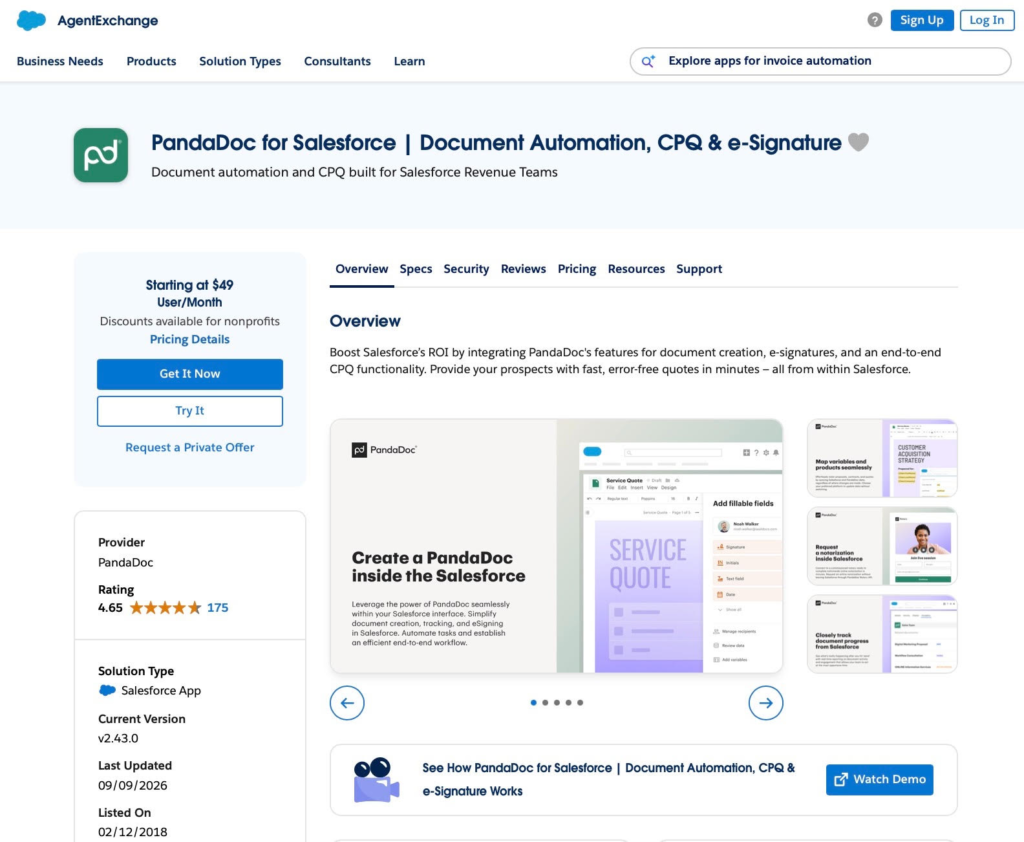
PandaDoc CPQ for Salesforce on AppExchange
PandaDoc, one of the Conga CPQ alternatives, combines CPQ with PandaDoc's broader document automation and e-signature capabilities. You can install the Salesforce package from AppExchange and then connect to a PandaDoc account. This brings PandaDoc functionality into Salesforce while retaining the broader PandaDoc platform and workspace.
Key features:
PandaDoc CPQ for Salesforce supports:
- Product and quote configuration: product selection, quote settings, quote sections, and configurable quote content.
- Pricing and quote rules: rules and formulas can calculate values, apply discounts, add or remove products, and update quote or line-item values.
- Guided selling: forms and guided questions can collect information and use the responses to configure quotes according to predefined rules.
- Salesforce data integration: Salesforce opportunity data can be pulled into PandaDoc workflows, while Salesforce product and line-item data can be mapped into quotes and quote-builder blocks.
- Quote and proposal creation: configured quotes can be inserted into PandaDoc documents using quote-builder blocks and combined with templates and other document content.
- Document and e-signature workflows: PandaDoc supports document creation, sending, tracking, and electronic signatures as part of its broader document platform.
Ideal use cases:
- Sales teams that need quoting and proposal creation in the same platform, combining product catalogs, pricing, customizable documents, and eSignatures.
- Businesses with configurable products and structured pricing requirements, using product bundles, rulesets, automated discounts, and approval workflows.
- Organizations that want CPQ connected to Salesforce while keeping quote creation, customer-facing documents, and eSignatures within the PandaDoc platform.
PandaDoc's CPQ workflow connects quote creation directly with document generation. A workflow can pull data from a Salesforce opportunity, collect additional information through a form, create a quote, apply quote rules, and use the resulting quote in a document generated from a PandaDoc template.
DealHub: CPQ as Part of a Quote-to-Revenue Platform
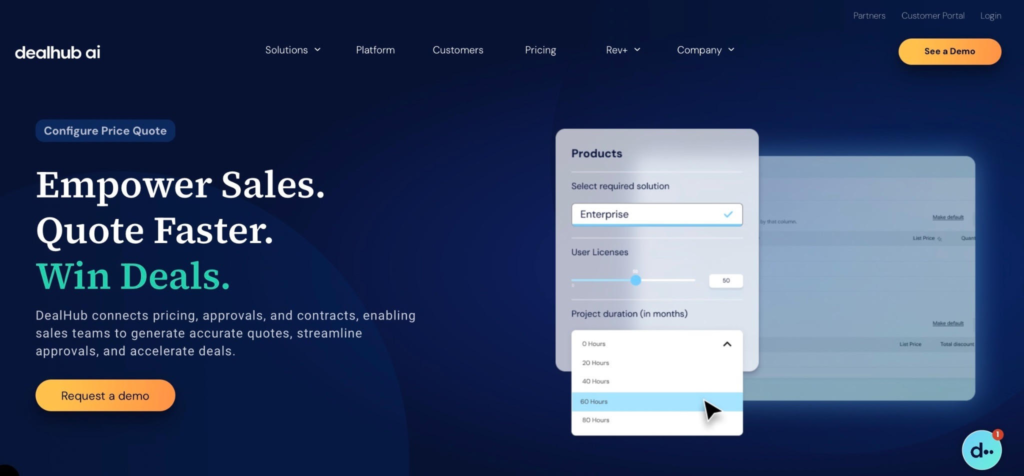
DealHub CPQ integrates with Salesforce CRM and forms part of DealHub's broader quote-to-revenue platform. Its CPQ functionality covers product configuration, pricing, quoting, approvals, and guided selling, while the wider platform also includes contracts, subscription management, billing, and buyer collaboration. The Salesforce integration syncs DealHub deal data with Salesforce and supports Salesforce standard objects.
Key features:
DealHub CPQ supports:
- Guided selling: question-based Sales Playbooks that guide reps through product and pricing configuration.
- Product configuration: configurable products, bundles, dependencies, and structured product catalogs.
- Pricing: fixed, tiered, and usage-based pricing models, along with dynamic discounts and pricing rules.
- Approvals: approval workflows linked to pricing and discount rules.
- Quote management: quote creation for new business, renewals, expansions, amendments, and co-terming scenarios.
- Salesforce integration: synchronization of deal data with Salesforce and support for Salesforce standard objects.
- Partner and channel quoting: quoting capabilities for partner and channel sales motions.
Ideal use cases:
- Sales teams managing complex quoting and pricing processes that require guided selling, configurable bundles, flexible pricing, discounts, and approval workflows.
- Organizations that need CPQ connected with contracts, subscriptions, billing, and other quote-to-revenue processes rather than quoting alone.
- Businesses managing multiple sales motions, including new business, renewals, expansions, amendments, and partner or channel quoting.
Overall, DealHub combines CPQ with a broader set of quote-to-revenue capabilities, including contract management, subscription management, billing, and buyer collaboration. Unlike the Salesforce-native solutions in this comparison, DealHub is its own CPQ platform that integrates with Salesforce and other CRM systems.
appero quote vs Conga vs DealHub vs PandaDoc: Key Features
After looking at each solution individually, it is time to compare their core CPQ capabilities. The table focuses on the features that most directly affect how products are configured, priced, discounted, and quoted.
Each comparison table shows a ranking to make the strengths and limitations of each solution easier to visualize. The final section brings the rankings together to determine the overall winner.
| appero quote vs Conga vs DealHub vs PandaDoc: Key Features | ||||
|---|---|---|---|---|
| Feature | appero quote | Conga Advantage CPQ | DealHub CPQ | PandaDoc CPQ |
| Product configuration | Product Groups, Product Properties, bundles, accessory products, and product dependencies | Product attributes, options, bundles, and configuration rules | Configurable products, bundles, product dependencies, and rules | Product bundles and quote rules for adding, removing, and updating line items |
| Pricing | Graduated prices, price dependencies, surcharges, and calculation rules | Price lists, price rules, and price matrices | Fixed, tiered, and usage-based pricing through Adaptive Pricebook | Rules, formulas, and lookup tables for dynamic pricing |
| Discounts | Manual and automated discounts, item- and total-level discounts, discount matrices, and multiple discounts per product line using up to 8 discount columns that can be combined | Discounts, promotions, and pricing rules, including percentage-, amount-, and volume-based discounts | Dynamic and volume-based discounts, pricing rules, promotional pricing, and discount limits with approval workflows | Line-item and total discounts, volume-based discounts, and rule-based discounting with configurable discount columns. |
| Guided selling | Product search and configuration in the quote editor, with internal comments displayed on products or in quote templates to guide sales reps | Guided selling using product attributes and configuration rules | Guided Selling Playbooks | Guided-selling forms with conditional logic |
| Quote creation | Templates, modules, merge fields, and Lightning Editor with live quote and PDF preview and real-time calculations | Catalog and cart-based configuration, pricing, finalization, and quote/proposal generation | Guided Quote Configuration | Workflow-based quote creation using Salesforce data and templates |
| Approvals | Approval processes and lower price limits, with support for native Salesforce Approval Processes and Flow to build custom approval logic | Approval workflows and rules with configurable criteria, approval steps, assignees, and dependencies | Automated pricing and discount approvals | Conditional approval workflows based on document value, discounts, quote variables, and other quote values |
| Quote documents | Custom quote layouts with company branding, images and product images, plus built-in PDF generation with no additional PDF generator required | Proposal documents generated from customizable templates with Salesforce data and PDF/DOCX output | Document generation and branded sales proposals from customizable templates, with dynamic content and PDF export | Customizable proposals and documents from reusable templates, with branding and dynamic content |
| Stars achieved | ⭐⭐⭐⭐ | ⭐⭐⭐⭐⭐ | ⭐⭐⭐⭐⭐ | ⭐⭐⭐⭐⭐ |
All four solutions provide a strong set of CPQ capabilities, but their strengths differ depending on the business requirements. While enterprise tools like Conga excel at highly complex product configurations, appero quote delivers a streamlined, intuitive configuration engine for standard product bundles and dependencies without the heavy admin overhead. A company looking for a focused CPQ solution or Revenue Cloud alternative may not need the additional capabilities of a broader platform, while another business may specifically need advanced configuration, guided selling, subscription management, document workflows, or other features beyond core quoting. More functionality can also mean additional cost, implementation work, and administration.
Security and Data Architecture: appero quote vs Conga vs DealHub vs PandaDoc
For Salesforce teams, security is closely tied to where CPQ data is stored and processed and whether the solution requires data to move between Salesforce and another platform. The architecture can therefore be as important as the security certifications a vendor reports.
| Security and Data Architecture: appero quote vs Conga vs DealHub vs PandaDoc | ||||
|---|---|---|---|---|
| Area | appero quote | Conga Advantage CPQ | DealHub CPQ | PandaDoc |
| Architecture | Runs natively in Salesforce | Runs in Salesforce through managed packages | CPQ platform with Salesforce integration; quote data is stored in DealHub and synchronized with Salesforce. | PandaDoc platform integrated with Salesforce through a Salesforce package and connected account |
| Data flow | Quote-process data remains in Salesforce; no third-party data transfer by default | CPQ data is stored and processed in Salesforce | Deal data is synchronized between DealHub and Salesforce | Salesforce data is transferred to PandaDoc; two-way synchronization is available for supported configurations |
| Security / compliance | Salesforce security review for the AppExchange managed package and Salesforce security model | Salesforce security review for the AppExchange managed package and Salesforce security model | ISO 27701, ISO 27001, ISO 22301, SOC 1, SOC 2, GDPR, and CCPA | SOC 2 Type II; GDPR, CCPA, and HIPAA |
| Stars achieved | ⭐⭐⭐⭐⭐ | ⭐⭐⭐⭐⭐ | ⭐⭐⭐⭐ | ⭐⭐⭐⭐ |
For Salesforce-centric CPQ, appero quote and Conga Advantage CPQ receive 5 stars because their CPQ functionality runs within Salesforce, keeping the architecture and CPQ data within the Salesforce environment. DealHub and PandaDoc receive 4 stars because their broader platforms require data to move between Salesforce and an external system. This does not mean that external platforms are less secure. It means they introduce an additional system and data-integration layer that Salesforce teams need to consider.
appero quote vs Conga vs DealHub vs PandaDoc: Ease of Use
Ease of use in CPQ is about more than the quote screen. A solution may be easy for sales reps to use but take more work for admins to set up and maintain. More advanced configuration can give admins more control, but it can also make the system harder to learn.
| appero quote vs Conga vs DealHub vs PandaDoc: Ease of Use | ||||
|---|---|---|---|---|
| Ease-of-use aspect | appero quote | Conga Advantage CPQ | DealHub CPQ | PandaDoc CPQ |
| Who can set it up | Salesforce admins can configure the app; appero also provides implementation support | Salesforce/CPQ administrators; complex configurations require knowledge of the Conga CPQ model | DealHub and Salesforce administrators, depending on the setup | Salesforce admins handle the Salesforce integration; PandaDoc admins manage the connected PandaDoc setup |
| Learning curve | Easy | High | Moderate | Moderate |
| Training / support | Vendor implementation and support available | Conga provides CPQ training; training is particularly relevant for administration and complex configuration | Vendor-led implementation and training available | Setup documentation and support; training may be needed for more advanced workflows and CPQ configuration |
| Stars achieved | ⭐⭐⭐⭐⭐ | ⭐⭐⭐ | ⭐⭐⭐⭐ | ⭐⭐⭐⭐ |
In this section, appero quote gets 5 stars because Salesforce admins can manage the setup without having to learn another platform, while vendor support is available when needed.
DealHub and PandaDoc get 4 stars because their setup involves learning both Salesforce and another platform. Conga gets 3 stars because, although vendor training and support are available, its broader CPQ model adds more complexity for both admins and users.
Final Comparison: Which Salesforce CPQ Fits Best?
Choosing a CPQ solution is not just about the number of features. The right fit depends on quoting requirements, Salesforce architecture, and how much setup and administration the business is prepared to handle.
This comparison covered three areas: CPQ capabilities, security and data architecture, and ease of use.
| Final Results: appero quote vs Conga vs DealHub vs PandaDoc | ||||
|---|---|---|---|---|
| Section | appero quote | Conga Advantage CPQ | DealHub CPQ | PandaDoc CPQ |
| Feature Comparison | ⭐⭐⭐⭐⭐ | ⭐⭐⭐⭐⭐ | ⭐⭐⭐⭐⭐ | ⭐⭐⭐⭐⭐ |
| Security and Data Architecture | ⭐⭐⭐⭐⭐ | ⭐⭐⭐⭐⭐ | ⭐⭐⭐⭐ | ⭐⭐⭐⭐ |
| Ease of Use | ⭐⭐⭐⭐⭐ | ⭐⭐⭐ | ⭐⭐⭐⭐ | ⭐⭐⭐⭐ |
| Total Stars Achieved | 15 ⭐ | 13 ⭐ | 13 ⭐ | 13 ⭐ |
Based on the three comparison categories appero quote stands out in this comparison because it combines the full set of core CPQ capabilities with a Salesforce-based architecture and the lowest learning curve among the four solutions. The other three products offer broader capabilities in specific areas, but they also require more platform knowledge or configuration.
Leave a Reply